
Published September 15, 2026
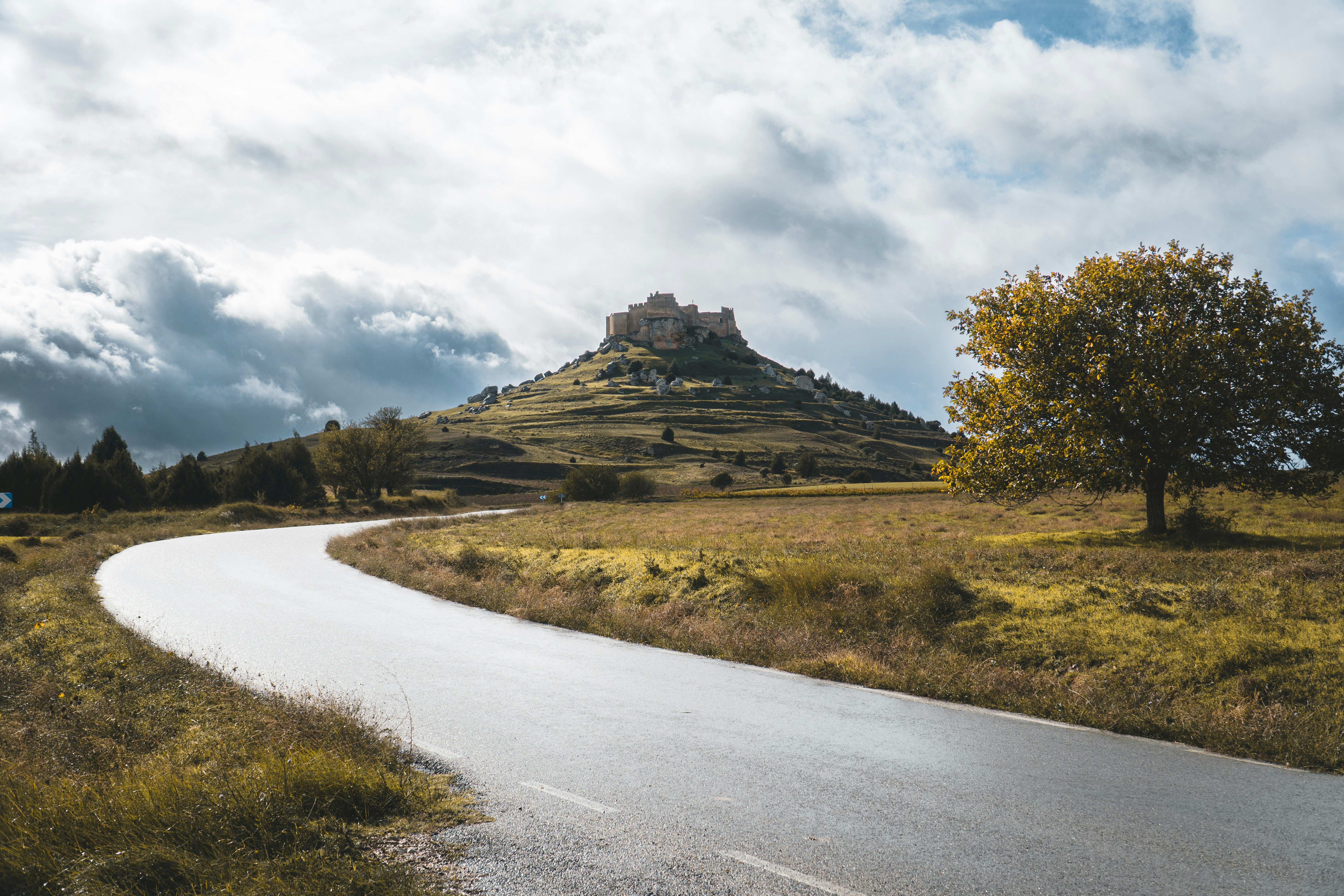
Back road to Gormaz castle in autumn, a sample slow weekend getaway by car. Photo by Luis Georg Müller on Unsplash.
Slow weekend getaways: how to actually switch off when summer is ending
There is a moment in September (it might be a random Monday, it might be when you fold the last beach towel) when you feel that summer has ended before you were ready. The calendar fills up again, the kids go back to school, work resumes its cruising speed and you ask yourself when the last time was you did something without checking the clock.
The answer is usually: on holiday. And the next question is: what if you don't have to wait until next summer?
September is, paradoxically, the best month of the year to slip away. Coastal destinations empty out suddenly. Inland villages get their rhythm back. Prices drop. The light changes: warmer, lower, more photogenic. And nature makes that silent transition that nobody has time to see in August.
You only need a weekend, a car and to know what kind of plan you are after. Not the destination, the plan. Here are five that always work.
1. The village that is in no guidebook
Not the pretty village from the list of the ten most beautiful in Spain. You already know that one — there is a queue for the photo and the restaurant is booked three weeks in advance. The other village. The one that appears on the map as a small dot between two regional roads, with a Romanesque church, three bars and a square where retirees play cards at six in the afternoon.
That village exists within two hours of any Spanish city. And the only way to get there is by car, along a road with no marked verge but which in September smells of dry straw and ripe grapes.
The plan: arrive on Friday evening, have dinner at the only bar that serves dinner, sleep in the only rural house run by the village lady, wake up without an alarm, have breakfast with whatever there is and spend the morning without any specific goal. In the afternoon, head back.
What you take home: the feeling that time has moved more slowly than usual. Which is exactly what you were after.
Why you need a car: because that village has no train station and no bus stop worth mentioning. Because the freedom to arrive when you want and leave when you decide is part of the plan.
2. The night in a rural house with no wifi
It is not a forced digital detox. It is simply choosing accommodation where the connection is bad or non-existent and letting that do the job on its own. No apps to lock your phone, no commitment not to look at the screen. Just a house with a fireplace (you may not need to light it in September), a garden, silence and the real possibility of reading an entire book over two days.
In September rural-house availability shoots up. Prices drop around 30% compared to August. And the owners, relieved after the high season, have time to tell you things about the place that no Google review carries.
The plan: book a house with a garden or outdoor terrace. Bring food to cook — village market on Friday afternoon. Bring a book you have been months without starting. Plan nothing else.
What you take home: having slept eight hours. Having cooked something calmly. Having finished at least three chapters.
For families: children in a rural house with a garden do not need organised entertainment. Nature and space do the work — something impossible to verify in a beach apartment in August.
3. The hiking route with no goal
Not the 22-kilometre route with 900 metres of elevation you have saved since January. That one is for when you want to test yourself. This is the other one: three or four hours, starting at a forest car park, leading to no particular peak but crossing a holm-oak forest, descending a ravine with water and ending at a spring where someone has left a plastic cup.
In September the mountains are less busy than in summer, the temperature is perfect for walking and the afternoon light makes any Mediterranean landscape look painted.
The plan: pick a circular route of under 15 kilometres in a nearby natural park or sierra. Leave at nine in the morning. Bring a sandwich. No music — listen to what is around you.
What you take home: the good kind of tiredness. The one that makes you sleep without thinking.
For families: short routes through natural parks with kids work better in September than in any other month — no August heat, no July crowds. Many natural parks along the Mediterranean arc have routes specifically marked for families with young children.
4. The producers' market and the Sunday pantry
There is a version of gastronomy that has nothing to do with starred restaurants or "best of Spain" lists. It has to do with getting up early on a Saturday, driving forty minutes to the weekly market of an inland village and buying tomatoes that taste of tomato, cheese that smells of cheese and wine from a cooperative that exports nothing because it does not need to.
September is the month of the grape harvest, figs, the first mushrooms in some areas and seasonal peppers. It is the time of year when producers' markets have the most variety and the best produce.
The plan: find the nearest weekly market with actual local producers — not the craft market, the food one. Arrive before ten. Shop without a list. Head back to the rural house or apartment and cook with whatever you found.
What you take home: a pantry. And the memory of having eaten something that did not come from any supermarket.
For families: producers' markets are one of the best informal educational resources for children — they see where food comes from, talk to the people who produce it and learn without anyone planning for them to.
5. Swimming in a river, reservoir or lagoon out of season
In August, rivers and reservoirs with public access are packed. In September, those same places are almost empty. The water is still perfectly swimmable — in many inland and southern areas, water temperature in September exceeds 22 degrees — but the towels no longer touch and the car park is empty.
There is something qualitatively different about swimming in a river in September. The silence, the absence of sunshades, the possibility of staying for two hours without anyone occupying the square metre next to you.
The plan: find a reservoir, river or lagoon with free access within an hour and a half of your city. Check swimming conditions — many have designated areas with up-to-date information on council or river-basin authority websites. Bring a cooler, a hammock and nothing else.
What you take home: the version of yourself that does not check the phone for three hours straight.
For families: water with no waves or strong currents is perfect for small children. And the absence of September crowds turns what would be a logistical odyssey in August into a genuinely relaxed plan.
The slow-weekend kit
Why September and not August
The argument is simple: in August you go where everyone goes. In September you go where you used to go in August, but with no one around.
** Average inland reservoir water temperature in September on the Spanish mainland according to AEMET.
Rural accommodation prices drop between 20% and 35% from the August peak. Secondary roads are clear. Restaurants have a table. Landscapes are exactly the same but in a different light — lower, warmer, with the first signs of the seasonal change that arrives slowly and elegantly in the Mediterranean.
And the car, in this context, is not just a means of transport. It is what makes the plan yours — arriving when you want, changing your mind halfway, discovering the turn that was not on the itinerary and turns out to be the best of the weekend.
That has no season.
Which of these plans appeals to you most this September?

Patricia Alcántara
Fleet Director at Malco
Specialist in fleet management and optimization of corporate mobility solutions.